
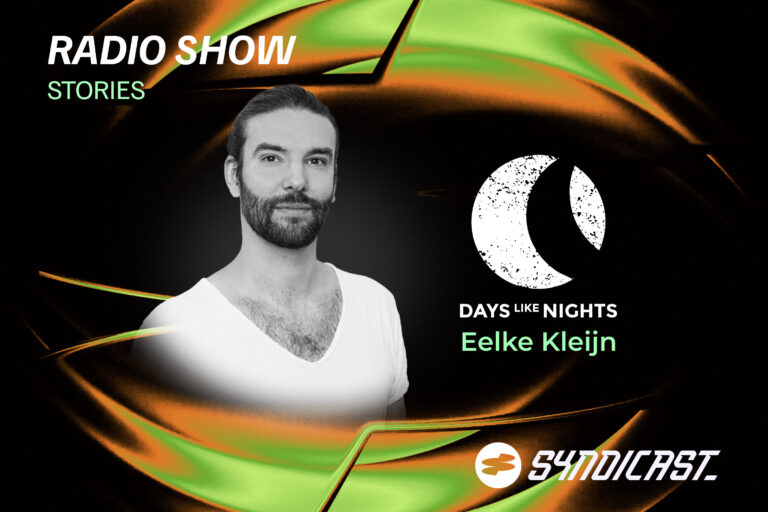
Syndicast Stories takes an under-the-hood look at the mechanics behind global radio success. We talk directly to the artists, labels, and show hosts who treat radio as a genuine growth engine, focusing on real strategy, operational decision-making, and the day-to-day reality of global syndication.
In this installment, we sit down with Eelke Kleijn, a producer and DJ whose work seamlessly bridges cinematic soundscapes and deep, melodic club music. As the founder of the globally renowned DAYS like NIGHTS label and radio show, Eelke has built a syndication network that currently reaches over 150 stations worldwide.
Below, he breaks down why he still personally handles every single second of his audio production, the strategic discovery “shortcut” that FM radio provides over streaming algorithms, and why he actively rejects traditional radio programming rules to keep his audience long-term.
The Foundation: From Studio to Global Stages
Tell us about DAYS like NIGHTS – how did it start, and what is the core concept?
Eelke Kleijn: DAYS like NIGHTS was originally founded as a record label back in 2017, born out of a partnership between myself, Armada Music, and my manager Jeroen Fontein. At that point in my career, I was already running a monthly radio show under a different moniker, but the frequency felt too restrictive to build real momentum. It made logistical and branding sense to streamline our operations, bring everything under one cohesive umbrella, and launch a brand-new, weekly radio program.
The core concept was to establish a dual-purpose platform: it needed to be a launchpad for the music we were putting out on the label, but equally a home for the unreleased records and deep cuts I was genuinely enjoying playing out in my live DJ sets. If I had to point to the one element that sets the show apart in a highly saturated market, it’s that I handle 100% of the audio production myself. It requires a significant time investment, but that direct involvement injects a highly personal touch that listeners notice immediately.
How has the show evolved in terms of reach and format?
Eelke Kleijn: When we started, I used to record many of the mixes in the studio. Nowadays, most shows are recorded live somewhere around the world. It adds to the “live experience” – people can listen to shows they actually attended. In terms of listeners, we are currently at around 150 radio stations worldwide, with another 20,000 to 30,000 people listening through our podcast.
The Strategy: The Radio “Shortcut”
In a digital world, why is radio still a powerful medium for you?
Eelke Kleijn: Radio remains an incredibly powerful tool because it excels at an audience acquisition phase that digital streaming platforms often struggle with: pure, unsolicited discovery. If a listener already knows who you are, they don’t need a middleman; they will go directly to your Spotify profile, search for you on Apple Music, or subscribe to your podcast feed. Those digital channels are fantastic for nurturing an existing fan base, but they operate heavily within user-defined bubbles.
Radio – and specifically traditional FM or DAB+ broadcasting – serves as a magnificent strategic shortcut directly into people’s daily routines, popping up in their cars, kitchens, and homes without them having to explicitly search for you. It bridges the gap by placing your sound in front of a massive, aggregate audience that might love your style of electronic music but simply hasn’t encountered your name yet.
What does radio offer that streaming platforms simply can’t?
Eelke Kleijn: The modern streaming landscape is entirely dominated by hyper-personalized, user-specific algorithms, which creates a massive hurdle for independent electronic artists trying to break out of their existing niches. It has become increasingly difficult to break through to a broader audience that would be deeply interested in your curation but remains entirely unaware that your project exists. Streaming platforms rely on the user making an active decision to click or relying on a lookalike algorithm that often just serves more of the same.
Radio completely flips that dynamic on its head by relying on human curation and shared broadcast moments. It offers a passive, lean-back listening experience where the audience trusts the station or the host to introduce them to something fresh, making it an irreplaceable tool for genuine, organic cross-market discovery.
The Horizon: Growth and Consistency
What’s next for the show? Any new formats or territories?
Eelke Kleijn: I try not to change the format too much. I stand by a couple of rules: all the music must be stuff I enjoy playing out, and I try not to repeat myself too often. People often say “radio is the power of repetition,” but I believe a close follower doesn’t want to hear the same music every week. I put a lot of effort into keeping each show unique.
The Industry: Authenticity vs. Automation
What are the biggest challenges radio hosts face today?
Eelke Kleijn: Without question, the single biggest challenge modern radio creators face is navigating the sheer, overwhelming volume of content being uploaded to the internet every single day. The barrier to entry has completely dropped, meaning you aren’t just competing with other syndication shows; you are competing with millions of algorithmic playlists, live streams, and on-demand podcasts.
Because of this noise, it is incredibly difficult to capture a listener’s initial attention, and it is ten times harder to give them a compelling reason to build a weekly habit and keep coming back. Creators have to think deeply and honestly about what defines their unique brand DNA and positioning within today’s fragmented media landscape, because generic curation simply gets swallowed up.
How do you keep the programming fresh while staying true to the show’s identity?
Eelke Kleijn: For me, preserving that core identity comes down to the deliberate decision to keep the workflow entirely hands-on. I don’t use programming assistants or external consultants; I select every record, arrange the musical progression of the sets, record all of my own vocal voiceovers, and handle the final audio editing and mastering. It is an immense amount of labor, easily eating up anywhere from half a day to a full working day every single week out of my schedule.
However, that time investment is exactly why the show maintains its integrity. It means I retain absolute, top-down quality control over every single transition, spoken word, and sonic texture that goes out to our partner stations, ensuring the brand never feels corporate or detached.
What is the biggest mistake you see shows make when trying to scale?
Eelke Kleijn: The absolute biggest pitfall I observe is the temptation to outsource the entire operational and creative pipeline the moment the show starts gaining traction. It completely understands why artists do it – when you are managing an intense international touring schedule, balancing studio production deadlines, and running a business, handing your radio show off to a ghost-producer or marketing agency seems like a smart management decision.
But you have to stop and ask yourself a fundamental strategic question: can you honestly expect to maintain a distinct, authentic identity if you outsource the very creative elements that form the foundation of that identity? The moment a show begins using automated voice-tracking, generic scriptwriters, or third-party track curators, the audience can sub-consciously sense the drop in authenticity, and the unique bond you’ve spent years building with your community quickly evaporates.
The Syndicast Connection
How has working with Syndicast contributed to your growth?
Eelke Kleijn: Partnering with Syndicast has been an absolute game-changer for our international expansion, particularly when it comes to breaking into new geographical markets and securing airtime on prime regional stations that we wouldn’t have had the bandwidth to pitch to directly. Beyond the pure network growth, it has completely transformed our internal day-to-day operations by streamlining our entire delivery infrastructure.
Manually preparing, formatting, and securely delivering a high-resolution, time-sensitive radio asset to well over 100 disparate global stations – all with different technical specifications, delivery deadlines, and upload portals – is an administrative nightmare to manage on your own. It is an incredibly heavy operational burden, and I am profoundly grateful that we can let Syndicast handle that entire distribution pipeline automatically, allowing my team and me to keep our focus entirely on producing the best possible music and show content.
The Mechanics of Scaling Without Compromise
Eelke Kleijn’s approach to DAYS like NIGHTS highlights a critical reality of modern music branding: scaling a global footprint doesn’t have to mean diluting the product. By treating FM radio as a deliberate shortcut for audience acquisition and resisting the urge to automate his creative voice, Eelke has built a sustainable, high-retention broadcast model that spans 150 stations worldwide.
The strategic takeaway for independent show hosts, artists, and labels is clear. Sustainable growth requires a strict division of labor. If a creator’s hours are consumed by navigating disparate technical delivery specifications, shifting time zones, and manual upload portals for dozens of individual carrier stations, the time left for curation, production, and core artistry suffers.
Moving away from manual distribution bottlenecks toward a centralized system allows creators to retain total, uncompromising control over their brand identity. By leaving the operational pipeline to automated architecture, global scale becomes a leverage point rather than an administrative burden.



 English (UK)
  Español
  Deutsch
  Français
  Italiano
  Magyar
  Polski
  Português