
Have you ever heard a song on the radio and noticed that it did not sound quite like the version you know from Spotify?
The release may be the same, but radio does not always use the standard streaming master exactly as it was delivered. Stations have IDs, sweepers, presenter links and other imaging to fit around the music, while labels and artists can also supply specially produced versions created specifically for broadcast.
Artist Promo Edits and Power Intros are two examples. They are closely related, but they serve slightly different purposes.
An Artist Promo Edit incorporates the artist’s own voice into a specially produced version of the song. A Power Intro builds on that idea but extends part of the intro by four bars, creating dedicated space for the radio station to add its own ID or imaging.
That small difference can completely change how the song is presented on air.
Why Radio Uses Special Versions of Songs
Streaming and radio present music in very different environments. On Spotify, the listener deliberately selects a song, album or playlist. They can already see the artist and song title on the screen, and there is no broadcaster that needs to identify itself between records.
Radio has additional layers. A station needs to maintain its own sound while moving continuously between music, presenters and imaging. An ID may need to sit over the beginning of a song. A presenter may talk up to the vocal. An artist voice can introduce a new release. The transition has to work musically without making the station sound as though separate pieces of audio have simply been placed next to each other.
The original commercial master does not always make that easy. Many current songs have extremely short intros, sometimes reaching the vocal or hook within seconds.
Specially produced radio versions give the production team more to work with. They do not change what the song is. They change how it can be presented.
What Is an Artist Promo Edit?
For music promoted through Syndicast, an Artist Promo Edit is created specifically for the release.
The artist records a short voice message introducing themselves and the song. A typical recording might be: ‘Hey, this is [artist name], and you’re listening to my song [track title].’ This can be followed by a neutral line such as: ‘On your favourite station.’ If another artist features on the release, that can be included in the recording as well.
The wording is intentionally not tied to a particular broadcaster. The artist does not need to record separate versions for dozens of stations, and the same finished edit can therefore be used across different Syndicast radio partners.
The raw artist recording is only the starting point. The production is what turns it into an Artist Promo Edit. The voice has to work with the structure, timing and energy of the record.
The end result is a finished radio version rather than a voice clip placed in front of the standard master. For a new release, that gives the station something extra to put on air: the artist is effectively introducing their own record inside the produced version of the song.
What Makes a Power Intro Different?
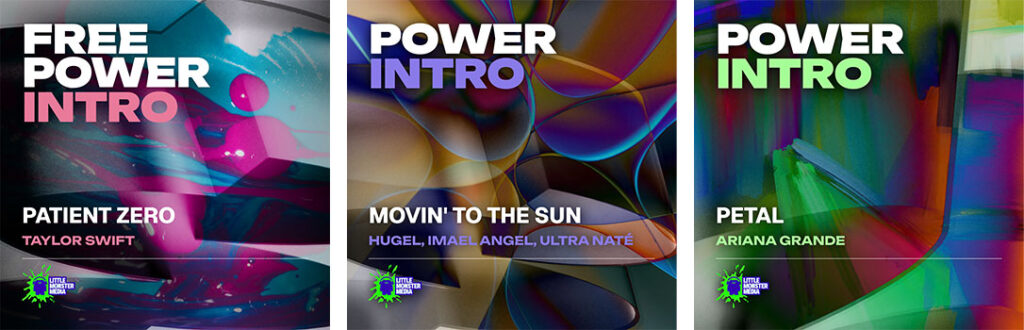
A Power Intro uses the same basic production approach but adds one important feature: four additional bars of music (in Syndicast cases).
Those four bars are there for the station. They create a clean musical section over which the broadcaster can place a station ID, sweeper, voiceover or other imaging before the song moves into its normal structure.
This is particularly useful when the original song has a very short intro. Without additional space, the station may have only a few seconds before the vocal begins. With the Power Intro, the production team has a predictable section in which to place the station branding.
The station can therefore customise the version without needing a completely new master produced specifically for that broadcaster. One station might add a short spoken ID, another could use a sung jingle or produced sweeper. The underlying Power Intro remains usable by both because the artist does not name either station.
This is where the Power Intro differs most clearly from the regular Artist Promo Edit. Both are produced around the music and artist voice, but the Power Intro deliberately gives the broadcaster additional room to become part of the production.
Artist Promo Edits vs Power Intros
The easiest way to understand the difference is to look at how the two versions are built and how the station can use them.
| Artist Promo Edit | Power Intro | |
| Main feature | Artist voice integrated into the song | Artist promo or artist ID with extra space for station imaging |
| Artist recording required | Yes | Yes |
| Station-specific by default | No | No |
| Artist mentions the station name | No | No |
| Station can add branding | Depending on the available section | Yes, this is the main purpose |
| Song intro modified | As part of the produced edit | Yes, with an additional four-bar section |
| Best for | Artist-led radio presentation | Artist-led presentation combined with station branding |
The difference is therefore not that one contains an artist and the other contains station imaging. A Power Intro can contain both. The important difference is the additional musical space deliberately created for the broadcaster.
Song-Specific Promos and Generic Artist IDs
There is one more distinction worth understanding, particularly when browsing content inside Syndicast.
For songs promoted through Syndicast, the Artist Promo recording is specific to the release. The artist introduces themselves and the song being promoted, and that recording is then used to produce the special version.
The Syndicast Imaging Store also contains content produced from generic artist IDs. In these recordings, the artist identifies themselves but does not introduce one particular release. Because the voice recording is not tied to a specific song campaign, it can be used as the basis for different radio imaging productions.
This gives the Imaging Store a broader catalogue of material. Some of these assets are available free to registered stations, while others are available as premium imaging.
The distinction is useful for programmers. A song-specific Artist Promo Edit is connected directly to the release. A generic artist ID is a production resource that can be used more flexibly within station imaging.
Did You Know You Can Already Find Them in Syndicast?
Radio stations using the platform can already find both Artist Promo Edits and Power Intros as part of the content available to them.
When browsing New Releases, radio music editors can discover new songs and, where an Artist Promo Edit has been produced, download the special radio version alongside the standard versions of the release. There is no need to contact the artist or label separately to request it; the produced edit is already available with the song.
The Imaging Store is where stations can explore Power Intros and other professionally produced radio imaging elements. Many of the Power Intros available there are created by our own production team, using both release-specific material and generic artist IDs depending on the production. Stations can find both free imaging and premium packs, giving them the option to use ready-made content or take the production further with their own station branding.
The store also features imaging from Little Monster Media, expanding the range of professionally produced content available to stations. You can read more about the collaboration in Syndicast Partners with Little Monster Media to Expand Its Radio Imaging Offering.
Together, these two areas serve different parts of the radio workflow. New Releases is where stations discover the music and any special Artist Promo Edits produced for individual releases, while the Imaging Store provides Power Intros, imaging packs and other production elements that can be used to shape the station’s own on-air sound.
And that brings us back to the reason the same song can sound different on radio than it does on Spotify. The recording may be familiar, but radio adds another layer of production around it.
Make Every Song Sound Like Your Station
Discover Artist Promo Edits, Power Intros and other broadcast-ready content created to help your station sound more distinctive on air.
Explore Our Radio Station Content →Gyakran Ismételt Kérdések
What is an Artist Promo Edit?
An Artist Promo Edit is a specially produced radio version of a song incorporating a recording from the artist. For releases promoted through Syndicast, the artist introduces themselves and the specific song.
What is a Power Intro?
A Power Intro uses the same radio production concept but adds four bars of music to create space for the station’s own ID, sweeper or imaging.
Are the versions made for one particular radio station?
No. The versions distributed through Syndicast are station-neutral. Individual stations can customise a Power Intro by adding their own imaging to the extended section.
What is a generic artist ID?
A generic artist ID contains the artist identifying themselves without introducing one particular song. Syndicast uses these recordings in selected Imaging Store productions, including free and premium content.
Where can I download Artist Promo Edits?
Artist Promo Edits are available with selected releases through the platform.
Where can I find Power Intro packs?
Complete Power Intro packs and other radio imaging elements can be found in the Imaging Store section of the platform.
Make Your Music Sound More Like Radio
Discover Artist Promo Edits, Power Intros and other broadcast-ready content created to help your station sound more distinctive on air.




 English (UK)
 Español
 Deutsch
 Français
 Italiano
 Magyar
 Polski
 Português